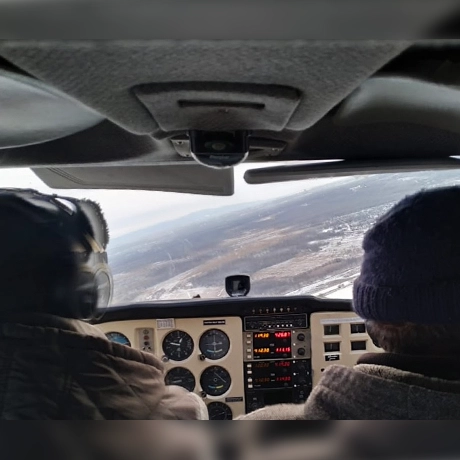


LOVES PARK, Ill.—A one-of-a-kind aviation ministry is flying into the remotest areas of Far East Russia in the heart of winter so that “frostbite evangelists” can share the Gospel.
In Russia’s Far East—home to the vast frozen tundra of Yakutia, officially the coldest inhabited place on earth—temperatures in January and February often plummet to minus 58 degrees Fahrenheit, minus 50 Celsius.
At such extremes, exposed skin suffers frostbite in seconds, and eyebrows freeze solid.
But that does not stop missionary pilots supported by Illinois-based Slavic Gospel Association (SGA) from landing on snow-covered runways in the “middle of nowhere” to take the “good news” to many isolated Russians, including indigenous minorities, who have never heard about Jesus Christ.
Their U.S.-built Cessna airplanes can be fitted with skis to land in the most difficult conditions, often visiting sparsely populated villages hundreds of miles apart above the Arctic Circle.
In addition to being skilled pilots, the missionaries also have to be their own mechanics. If their frozen plane’s engine won’t start, they have to fix the problem themselves—or face being stranded for days.
Siberian Tigers, Open-Hearted People
On the ground, they have to watch out for roaming wolves, bears, and even Siberian tigers.
Despite all the challenges, the missionaries are warmly welcomed by the local people who are largely open to hearing the Gospel message, said Eric Mock, SGA’s senior vice president of ministry operations.
Often, villagers are so shocked to see an airplane landing that they come running. “The kids want to sit in the pilot’s seat and meet the pilot,” Mock said. “They’re eager to hear whatever he has to say, including the story of Jesus.”
These are Russia’s “most forgotten people, isolated from the rest of the world,” he said. “In the U.S., it isn’t difficult to get from Point A to Point B, but imagine having to cross hundreds of miles of frozen land and rivers to get anywhere.”
“We’re talking about a region—Far East Russia—that’s almost the size of the continental United States, yet has a population of only eight million, and just 3,500 known Christian believers.”
With so few people scattered across such a vast region, it equates to one person per square kilometer.
The aviation ministry and its airborne evangelists have a single goal—to “make the Gospel available to the ends of the earth,” said Mock, himself a pilot who has flown with the ministry in Russia’s Far East. “Without the aviation ministry, many of these places would be inaccessible.”
SGA supplies fuel and essential parts to help keep the ministry’s three aircraft flying.
It is part of SGA’s wider ministry that supports thousands of local missionary pastors and local evangelical churches across Russia, the former Soviet Union, and Israel, equipping them to share the Gospel and help forgotten people, including widows and orphans.
Visiting Orphans in Siberia
A local SGA-supported team in Siberia’s Krasnoyarsk region braves icy roads and tracks to travel 350 miles visiting remote orphanages, part of the Orphans Reborn outreach.
“Many of these children feel unwanted and abandoned,” Mock said. “They’ve never felt the love of a parent, or heard that God loves them. The local Orphans Reborn teams show them the love and attention they’re craving, and share the Bible with them.”
Founded in 1934, Slavic Gospel Association (SGA, www.sga.org) helps “forgotten” orphans, widows and families in Ukraine, Russia, the former Soviet countries of Eastern Europe, Central Asia, and Russian-speaking immigrants in Israel—caring for their physical needs and sharing the life-transforming Gospel. SGA supports an extensive grassroots network of local evangelical missionary pastors and churches in cities and rural villages across this vast region.
PHOTO CUTLINE: RUSSIA’S ‘FROSTBITE EVANGELISTS’ TAKE TO THE AIR: Braving temperatures of 50 below freezing and Siberian tigers, missionary pilots supported by Slavic Gospel Association (SGA) take the “good news” to Far East Russia’s isolated villages in the heart of winter.